Grip Strength, Muscle Power and the Problem With Longevity Metrics
- Ben Lowe

- Jul 28
- 8 min read
Longevity content loves a single number. A grip-strength score. A BMI target. A biological age. One result that is meant to tell us whether we are doing well and what we should work on next.
There is nothing wrong with measuring these things. In many cases, the reason they became popular is that they are genuinely useful. The problem starts when we confuse a useful marker with the outcome we actually care about.
A test can help predict risk without being the thing that changes risk. A number can move in the right direction while the person becomes less healthy. This distinction matters, particularly in the world of longevity, where there is always a new score being presented as the answer.
A recent 2025 study comparing muscle power with grip strength gives us a useful way to think about this. It also points towards a much less exciting, but more honest, conclusion: there probably is no single longevity hack. The best approach is to keep developing the physical qualities of a capable, athletic adult.
Why grip strength became such a useful health marker
Grip strength has earned its place in health research. It is quick, inexpensive and easy to repeat. It can be measured in a clinic with a hand-held dynamometer, without complex equipment or a long testing appointment. We routinely measure grip strength here at Hurdle Health.
More importantly, low grip strength is consistently associated with poorer health outcomes. In the PURE study, researchers followed 139,691 adults from 17 countries. For every 5 kg reduction in grip strength, the hazard of all-cause mortality was 16% higher. Cardiovascular mortality was 17% higher, myocardial infarction was 7% higher and stroke was 9% higher (Leong et al., 2015).
That finding has not appeared in isolation. A 2022 systematic review and dose-response meta-analysis included 48 prospective studies and 3,135,473 participants. It found strong evidence that lower grip strength was associated with higher all-cause, cardiovascular and cancer mortality (López-Bueno et al., 2022).
Those are striking findings, but they do not mean that grip strength is magic. They mean that a simple grip test captures something important about the person being tested.

Grip strength is linked with age, muscle function, physical activity, nutrition, illness burden and general physiological reserve. It is a useful proxy for a much wider health picture. That is exactly why it predicts outcomes so well.
Prediction is not prescription
This is where the message often gets muddled. A measure that predicts an outcome is not automatically the intervention that improves that outcome.
An economist called Charles Goodhart described how statistical relationships can break down once they are used as targets. Marilyn Strathern later summarised the idea in a line that has become known as Goodhart’s law: “When a measure becomes a target, it ceases to be a good measure”.
Imagine two people record the same low grip-strength score. One buys a hand gripper and practises the exact test each evening. The other begins a well-designed training programme, becomes more active, builds muscle, improves their nutrition and gradually becomes stronger across their whole body.
Both people may improve their grip score. It would be a mistake to assume they have achieved the same health outcome.
This is not an argument against training grip. Strong hands are useful, and grip work can be a sensible part of a programme. It is an argument against treating the test as the treatment. A dynamometer can flag a problem. It cannot tell us the full solution.

BMI shows us the same problem
BMI is another measure that attracts more criticism than it deserves. It is simply body weight relative to height. It is quick, cheap and useful for identifying patterns of risk across large populations.
In an individual-participant meta-analysis of 239 prospective studies across four continents, the Global BMI Mortality Collaboration analysed data from around 10.6 million adults. After measures were taken to reduce the effects of smoking, existing disease and reverse causation, all-cause mortality was lowest in the BMI range of 20 to 25 kg/m². Above 25 kg/m², each additional 5 kg/m² was associated with a 31% higher hazard of all-cause mortality overall (Global BMI Mortality Collaboration, 2016).
So BMI is not useless. It tells us something. It just does not tell us everything.
BMI cannot distinguish muscle from fat. It does not tell us where body fat is stored, how fit someone is, what they eat, how strong they are or whether recent weight loss came mainly from fat or lean tissue.
That matters because two people can lower their BMI in very different ways. One might lose fat while resistance training, eating enough protein and maintaining a varied diet.
Another might follow a very restrictive diet, lose a meaningful amount of muscle and reduce the quality of their food choices. The number can move in the same direction while the wider health result is very different.
Diet-induced weight loss commonly includes some loss of lean mass. Resistance training and an appropriate diet can help preserve muscle and physical function during weight loss (Cava et al., 2017). The aim should therefore be improved health and body composition, not simply the lowest possible BMI.

A 2025 study compared strength with power
This brings us to the new study. Researchers used data from 3,889 men and women aged 46 to 75 in the CLINIMEX prospective cohort. Participants were followed for a median of 10.8 years (Araújo et al., 2025).
The researchers compared two measures of muscle function. Relative strength was measured using a handgrip dynamometer and adjusted for body weight. Relative muscle power was measured during an upper-body rowing movement, where participants were asked to move progressively heavier loads as fast as possible. Power was calculated in watts and also adjusted for body weight.
The distinction matters. Strength is the ability to produce force. Power is the ability to produce force quickly. In simple terms:
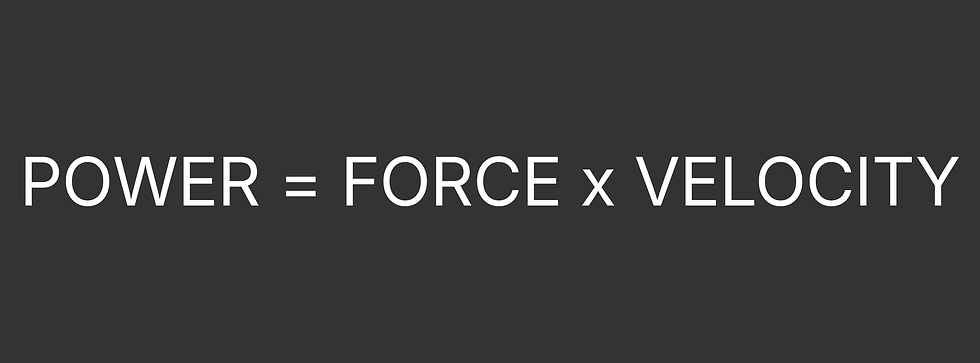
Relative muscle power was much more strongly associated with mortality than relative grip strength. Compared with the highest power group, men in the lowest group had an adjusted mortality hazard ratio of 5.88. In women it was 6.90. The equivalent figures for relative grip strength were 1.62 in men and 1.71 in women, and the confidence intervals for those strength estimates crossed 1 (Araújo et al., 2025).
That does not mean low power caused the deaths, or that power training will reduce mortality six-fold. This was an observational study. It tells us that relative power was a stronger predictor of survival in this cohort, not that the relationship is automatically causal.

Why might power tell us more?
The study was designed to compare prediction, not explain the mechanism. Any explanation here has to be treated as a reasonable theory rather than a finding from the paper.
One possibility is that power is harder to improve in isolation. A grip score can be raised by practising the exact grip task. Power still has some test-specific skill, but it depends on several physical qualities working together. You need a base of strength, the ability to recruit that strength quickly, coordination, movement confidence and enough practice to express it. In this study, the result was also divided by body weight, so the measure reflected what a person could produce relative to the body they had to move through life.
Power also matters in normal daily tasks. Standing from a chair, climbing stairs, lifting a bag, crossing a road quickly and reacting when you lose balance all require force to be produced within a limited amount of time. Being able to generate a large force eventually is not always enough.
This becomes more important with age. Muscle power tends to decline earlier and faster than maximal strength (Metter et al., 1997). In a study of 94 community-dwelling older adults, sit-to-stand leg power was more useful than knee strength for distinguishing people who had reported falls from those who had not (Simpkins and Yang, 2022). It was a small retrospective study, so it should not be overstated, but the finding makes practical sense. When someone trips, they do not have unlimited time to produce force.
Seen this way, power is not only a gym quality. It is a sign that someone has retained the ability to move with intent. It is one of the qualities we associate with an active, athletic adult.

Power should not become the next longevity hack
It would be easy to read this study and decide that power is now the only number that matters. That would repeat the same mistake.
Power is one useful marker. It does not tell us whether someone has good cardiorespiratory fitness, healthy blood pressure, enough balance to use that power, the mobility to access different positions or a body composition that supports long-term health. A high power score would not cancel out poor health in every other area.
The point is not to replace grip strength with power and start chasing a new score. The point is to stop expecting one measurement to describe the whole person.
Healthy ageing looks a lot like staying athletic. Not athletic in the sense of needing to compete, jump onto boxes or look like a fitness model. Athletic in the more useful sense: having enough fitness, strength, power, mobility, balance and physical reserve to meet the demands of your own life.
There is no clever way around consistently using the body. There is no single test that can replace training, movement, good nutrition, recovery and time. The closest thing we have to a longevity “hack” is to keep becoming a more capable human being.

How we use measures at Hurdle Health
At Hurdle Health, we use a range of outcomes because different people need different things. We may measure strength, power, balance, mobility, cardiorespiratory fitness, body composition or a task that is specific to your goals.
The measures help us understand where you are starting, choose what to prioritise and check whether the plan is working. They are not the final goal.
The final goal might be getting back to the golf course, feeling confident on the floor with your grandchildren, travelling without worrying about your knees, carrying your own bags, returning to a sport, running a marathon or simply knowing that your body can cope with more than it could six months ago.
We use the measures to guide the plan, not become the plan. The real outcome is more capability, more resilience and more healthy years spent doing the things you love.

References
1. Araújo, C.G.S., Kunutsor, S.K., Eijsvogels, T.M.H. et al. (2025). Muscle Power Versus Strength as a Predictor of Mortality in Middle-Aged and Older Men and Women. Mayo Clinic Proceedings, 100(8), 1319–1331. DOI: 10.1016/j.mayocp.2025.02.015
2. Cava, E., Yeat, N.C. and Mittendorfer, B. (2017). Preserving Healthy Muscle during Weight Loss. Advances in Nutrition, 8(3), 511–519. PMID: 28507015
3. Global BMI Mortality Collaboration (2016). Body-mass index and all-cause mortality: individual-participant-data meta-analysis of 239 prospective studies in four continents. The Lancet, 388(10046), 776–786. PMID: 27423262
4. Leong, D.P., Teo, K.K., Rangarajan, S. et al. (2015). Prognostic value of grip strength: findings from the Prospective Urban Rural Epidemiology (PURE) study. The Lancet, 386(9990), 266–273. PMID: 25982160
5. López-Bueno, R., Andersen, L.L., Koyanagi, A. et al. (2022). Thresholds of handgrip strength for all-cause, cancer, and cardiovascular mortality: a systematic review with dose-response meta-analysis. Ageing Research Reviews, 82, 101778. PMID: 36332759
6. Metter, E.J., Conwit, R., Tobin, J. and Fozard, J.L. (1997). Age-associated loss of power and strength in the upper extremities in women and men. The Journals of Gerontology Series A, 52(5), B267–B276. DOI: 10.1093/gerona/52A.5.B267
7. Simpkins, C. and Yang, F. (2022). Muscle power is more important than strength in preventing falls in community-dwelling older adults. Journal of Biomechanics, 134, 111018. PMID: 35228153
8. Strathern, M. (1997). “Improving ratings”: audit in the British University system. European Review, 5(3), 305–321. European Review, 5(3), 305–321


