Why Strength Training Might Be the Best Injury Prevention Tool for Runners
- Ben Lowe

- May 19
- 2 min read
Running is one of the most effective things you can do for your health.
It improves cardiovascular fitness, metabolic health, mental wellbeing, longevity, and resilience.
But it also comes with a problem.
Running is one of the most injury-prone physical activities in the world — responsible for more exercise-related injuries each year than almost every other form of training combined.
The good news?
Running is not inherently dangerous.
Most running injuries are not caused by running itself.
They are caused by poor tissue capacity meeting training loads the body is not prepared to tolerate.
And that is where strength training changes everything.
The Research Is Clear
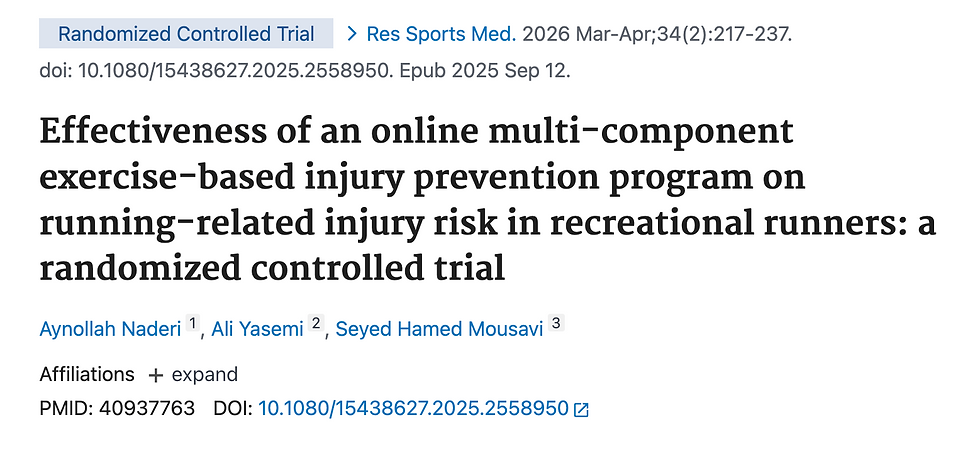
A recent randomised controlled trial compared two groups of recreational runners:
One group performed running training alone
The other combined running with structured strength training
The results were significant.
Runners who strength trained experienced:
~47% fewer overall running injuries
~54% fewer severe or “time-loss” injuries
In other words, they were not only getting injured less often — they were also less likely to miss training when injuries did occur.

Why Strength Training Works
Many runners think strength training is simply “extra fitness”.
It is not.
For runners, strength training is tissue preparation.
It improves the body’s ability to tolerate the repetitive forces involved in running.
Every step creates load through the feet, calves, Achilles tendon, knees, hips, and spine.
Over thousands of repetitions, weak or underprepared tissues eventually struggle to keep up.
Strength training helps by:
Increasing tissue capacity
Improving force tolerance
Enhancing muscular coordination
Improving stability and control
Reducing repetitive overload stress
The study’s strength programme focused on lower-body strength, core control, and stability work performed 2–4 times per week.
Nothing fancy.
Just structured, progressive training.
Most Running Injuries Are Overload Problems
The majority of common running injuries are not random accidents.
They are overload injuries.
Usually some combination of:
Too much running too soon
Poor recovery
Inadequate strength
Limited tissue capacity
Sudden spikes in training volume
This is why so many runners experience recurring issues such as:
Patellofemoral knee pain
Achilles pain
Plantar fasciitis
Shin splints
IT band irritation
Hip pain
Low back pain
The body simply loses its margin of safety.
Strength training helps widen that margin.

What Most People Get Wrong
One of the biggest misconceptions is that runners only need to “add a few strength sessions”.
But random lifting is not the same as structured strength training.
The benefits come from:
Progressive programming
Appropriate exercise selection
Consistency
Sufficient loading
Building a more complete athlete
Good strength training supports running performance while simultaneously reducing injury risk.

Lift + Run
Strength training does not “bulletproof” runners.
But it dramatically improves the body’s ability to tolerate running.
And that changes the equation completely.
The strongest runners are often the most durable runners.
So if your goal is to keep running consistently for years — rather than repeatedly stopping because of injury — strength training should not be optional.
It should be part of the plan.
At Hurdle Health, we help adults build strength, improve movement capacity, and train in a way that supports long-term health, performance, and confidence.


